
Start with the price after grants.
Net price means the estimated cost after grants and scholarships—money you usually do not repay. It is not the bill after taking out loans. Loans still have to be paid back. Work-study is money you earn through a job; it is not an upfront discount.
- Open each college’s official net price calculator. Use the same family details for each estimate.
- Check the year, who the calculator covers, and whether it counts merit scholarships. Save the result and date.
- List tuition, fees, housing, food, supplies, computer needs and travel. Check which costs the estimate includes.
- Compare the years needed for the full route. If it includes a later graduate degree, make a separate estimate for that stage.
Sources: U.S. Department of Education: calculators. Checked October 7, 2026.
Find your price, wherever you apply.
Compare the full yearly budget and the estimate after grants for each school on your list. Include tuition, fees, housing, food, travel, supplies and computer needs. Ask which studio costs are already counted.
- Resident tuition: a public college may charge less to students who meet its state’s residency rules. Do not assume that living there briefly qualifies.
- Private colleges: some have larger grants. Run the calculator before ruling a school in or out by its headline price.
- Commuting or transfer: compare travel, work time and remaining studio terms. Lower yearly tuition may still leave extra years to pay for.
A salary is before taxes and living costs. Median architect pay includes experienced workers; it is not a new graduate’s promise. Compare what you would need to cover across the full degree route.
U.S. Department of Education: net price calculators · Checked October 7, 2026.
Understand the math before trusting a number.
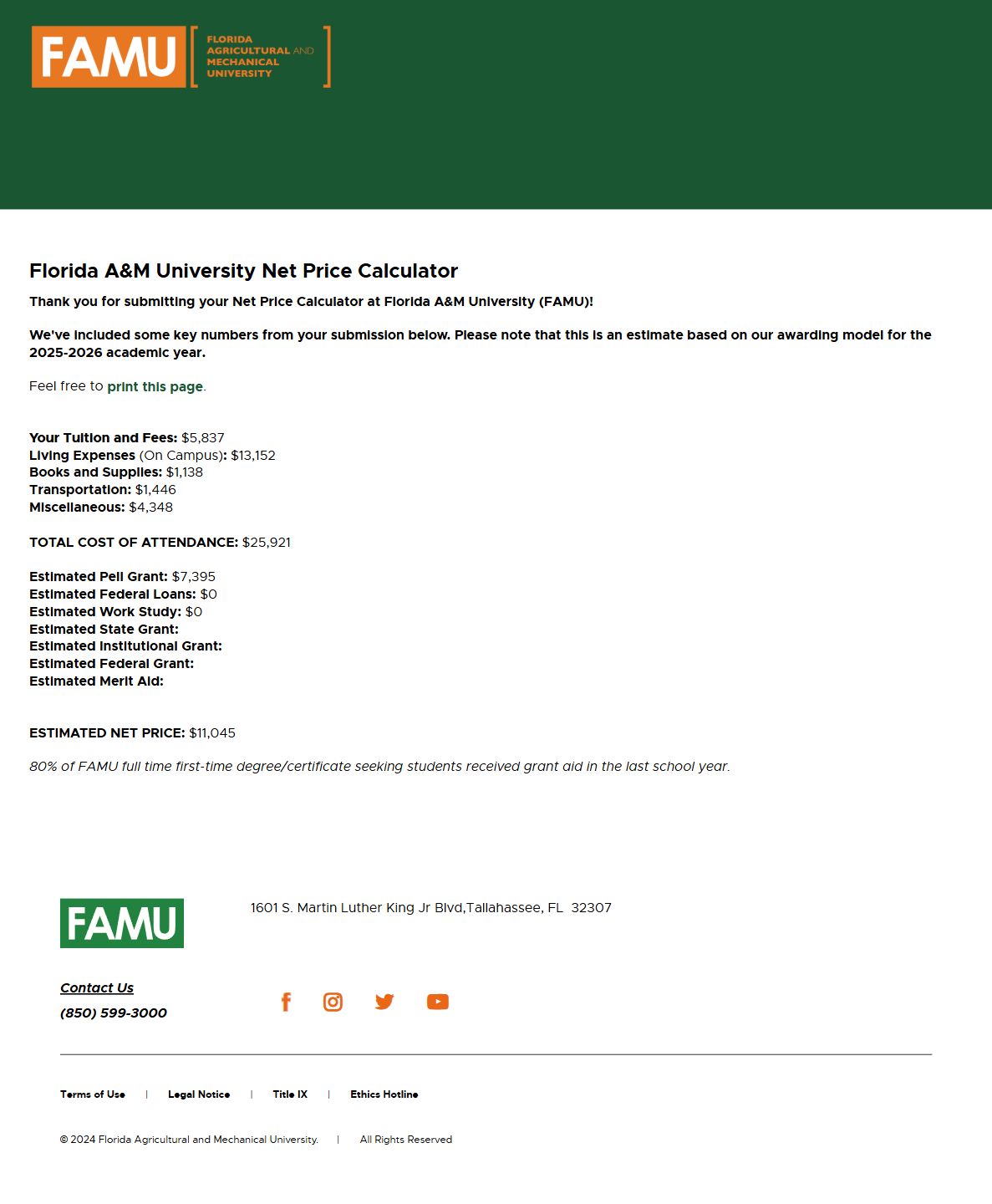
Teaching example using a dated budget—not an aid prediction. FAMU’s calculator receipt used a 2025–26 yearly budget of $25,921. Suppose a student receives a $7,395 grant. That grant amount is an assumption for this lesson, not an award to you.
Yearly budget: $25,921
Assumed grant: − $7,395
Cost after that grant: $18,526
A loan does not lower that $18,526 cost; it helps pay it now and must be repaid. Work-study is earned through a job. For your comparison, use your schools’ current calculators or actual offers and keep these amounts separate.
This is arithmetic, not a net price calculator result. The dated budget is included to show a real budget’s scale; it is not a suggested college or a current tuition quote. Use the budget and aid year for your own entry date. Historical budget receipt: its aid total is invalid, so use it only as evidence for the dated budget, not as a net price estimate.
Put the numbers in separate boxes.
Keep unknowns blank. Add grants first, then subtract that total from the full budget. List loans and work-study separately. Use “Add plan” for another pair of colleges.
| Item | College A | College B |
|---|---|---|
| College, degree and entry year | ||
| Estimate date and source | ||
| Total yearly cost before aid | ||
| Grants and scholarships | ||
| Cost after grants and scholarships | ||
| Loans offered (must repay) | ||
| Work-study offered (must earn) | ||
| Family funds available | ||
| Still to cover | ||
| Aid renewal rules | ||
| Years in this degree / later degree |
Copy your entries as text, download a text file, or choose to save on this device. Avoid saving on shared computers. Do not enter account numbers or tax documents.
Find aid without missing the date.
- Use the official FAFSA page to check the form for your entry year and eligibility. Federal aid is not available to every student; check the official citizenship and eligible-noncitizen guidance. School and state deadlines can be earlier than the federal deadline.
- Some colleges also use the CSS Profile or their own form. Check whether a fee waiver applies.
- Request application fee waivers when eligible. Portfolio upload fees may have a separate waiver process.
- Keep grant money, loans and work earnings separate when comparing offers. Check each scholarship’s renewal rules.
- If federal aid is not available to you, ask each school about its own grants, state aid and separate forms. If family information is missing, use the script to ask for a secure next step.